
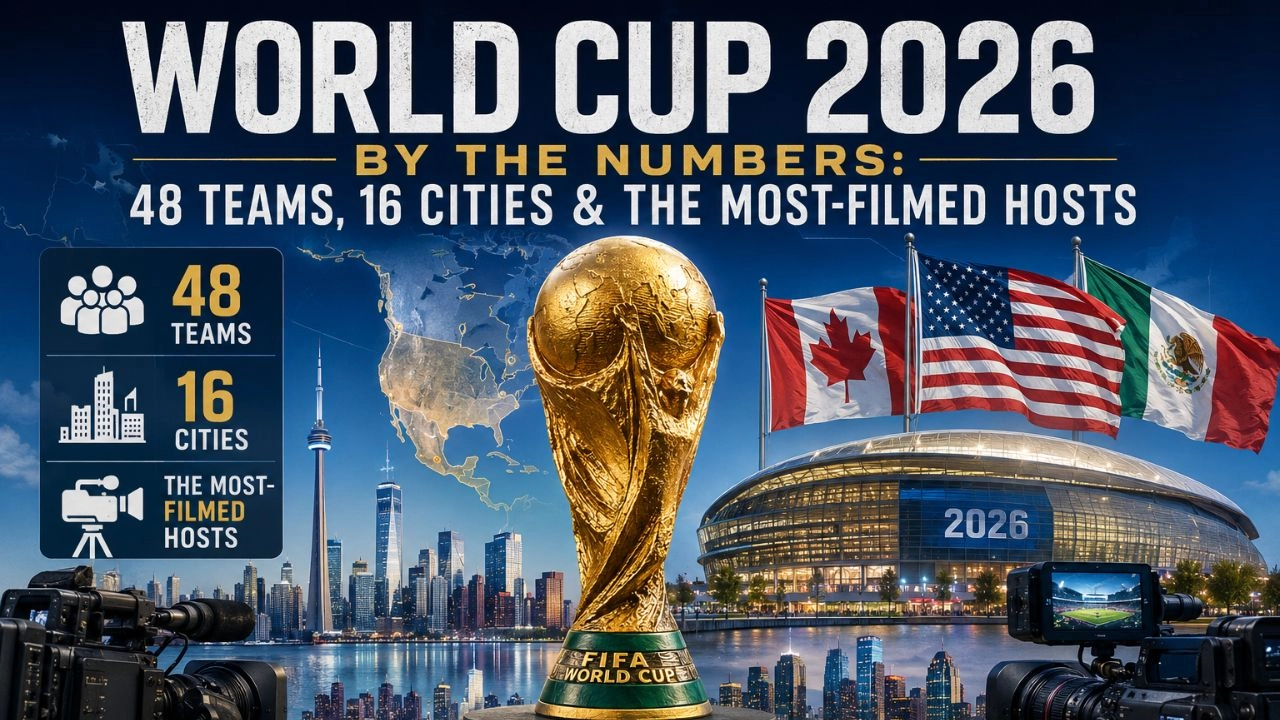
World Cup 2026 isn’t just big — it’s the biggest in history, by a mile. As someone who loves a good stat almost as much as a good filming location, I pulled the key numbers together and connected them to the screen world. Here’s the tournament by the digits.
Spoiler: this thing is roughly twice the size of the World Cup you grew up with.
| Detail | Info |
|---|---|
| Teams | 48 (up from 32) |
| Matches | 104 (up from 64) |
| Host nations | 3 — USA, Mexico, Canada |
| Host cities | 16 |
| Dates | June 11 – July 19, 2026 (39 days) |
Table of Contents
Then & now
For comparison, the 1994 World Cup (also in the USA) had 24 teams and 52 matches. The 32-team era ran from 1998 to 2022. So 2026’s jump to 48 teams and 104 matches is the largest expansion the tournament has ever seen — more games, more cities, more chaos. Confirmed fixtures are on the FIFA fixtures page.
The most-filmed host cities
Here’s my favorite stat angle: several host cities are also among the most-filmed places on the planet. Los Angeles tops the list, with New York, Atlanta, Toronto, and Vancouver all global production hubs. Basically, this World Cup is being played in cinema’s living room. We cover them all in the World Cup 2026 hub.
Why it matters
More teams means more nations represented, more first-timers, and more neutral fans with a reason to watch. Pair that with a backdrop of the world’s biggest film cities and you’ve got a tournament that’s as photogenic as it is competitive.
A few more numbers that matter
Some deeper digits: the field is split into 12 groups of four, with the top two plus the eight best third-placed teams advancing into the new 32-team knockout round. Sixteen stadiums share 104 matches across three nations and five-plus time zones — a logistical feat that’s never been attempted at this scale.
The human numbers are just as wild: organizers expect millions of in-stadium fans and a global TV audience in the billions, with host cities bracing for a tourism surge all summer. For perspective, the 1994 World Cup in the USA still holds the record for highest average attendance — and 2026 has nearly double the matches to fill.
My honest take: this isn’t just a tournament, it’s a continent-wide, month-long festival that happens to revolve around a ball. The scale is genuinely hard to wrap your head around until you realize there will be multiple matches every single day for weeks. If you love the where-was-this-filmed angle as much as the scoreboard, several of these host cities are also the most-filmed places on Earth — our World Cup 2026 hub maps them all, and the USA vs Paraguay guide kicks it off.
Why the scale matters to you: all those numbers translate into a very practical reality, there is something to watch nearly every day for over a month, often several matches back to back. That makes 2026 the most binge-able World Cup ever, but it also means planning helps, so pick your must-see fixtures early. The expanded field gives smaller nations a real shot at the knockouts, which historically produces the tournament’s most joyful underdog stories. And with matches spread across three countries and many time zones, there’s a kickoff to fit almost any schedule, whether you’re an early riser or a night owl. However you slice the data, 2026 is a bigger, bolder, more accessible World Cup, and that’s great news for fans both new and lifelong.
Frequently asked questions
How many teams are in World Cup 2026?
48 teams, up from 32 in previous editions, the largest field in World Cup history.
How many matches are in World Cup 2026?
104 matches, up from 64, across 16 host cities in three nations.
How long is World Cup 2026?
39 days, running from June 11 to July 19, 2026.
Discover more from A2Z Filming Location
Subscribe to get the latest posts sent to your email.