
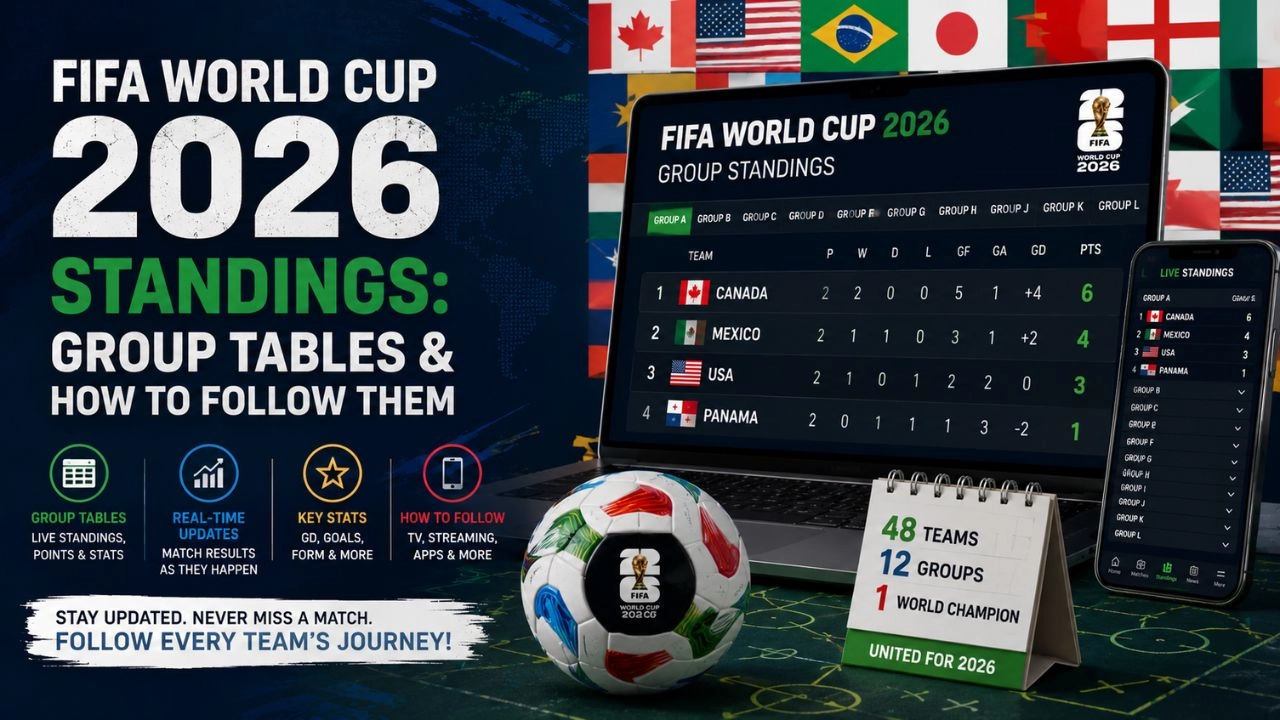
During the group stage, the standings change almost every hour, so knowing how to read them is half the battle. There are 12 group tables, and points work the classic way: three for a win, one for a draw. Let me explain how the tables decide who advances, including the tricky third-place math.
| Detail | Info |
|---|---|
| Group tables | 12 (A–L) |
| Points | Win 3, Draw 1, Loss 0 |
| Auto-advance | Top 2 per group |
| Also advance | 8 best 3rd-place |
| First tiebreaker | Goal difference |
Table of Contents
How the World Cup 2026 standings work
Each group of four plays a round-robin, so every team faces the other three once.
Teams earn three points for a win and one for a draw. The two highest point totals in each group advance automatically.
See who is in each group in our groups guide.
The tiebreakers that decide everything
When teams are level on points, FIFA applies tiebreakers in order.
| 1 | Goal difference |
| 2 | Goals scored |
| 3 | Head-to-head result |
| 4 | Fair-play / disciplinary points |
| 5 | Drawing of lots (last resort) |
That is why a late, seemingly meaningless goal can completely reshuffle a group.
The third-place race
This is the part unique to a 48-team World Cup. Finishing third does not automatically mean elimination.
The eight best third-placed teams across all 12 groups also advance to the Round of 32.
So a strong third-place record, especially goal difference, can be the difference between going home and reaching the knockouts.
Where to follow live standings
Tables update in real time across the major sports outlets and the official FIFA site.
For kickoff times tied to each table, use our schedule guide; for the knockout picture, see the bracket.
Everything is collected on our World Cup 2026 hub.
Standings timeline
June 11–27 — Group tables fill out over three match rounds.
June 27 — Final standings lock, advancers confirmed.
June 28 — Round of 32 begins based on those tables.
How to read a group table
A group table looks simple but packs a lot in. From left to right you will see games played, won, drawn, lost, goals for and against, goal difference and points.
Points are the headline number, but goal difference is the silent decider in tight groups.
The top two rows are the automatic qualifiers; the third row is where the nervous third-place math begins.
Why goal difference matters so much
In a four-team group, teams often finish level on points, and that is when goal difference takes over.
It rewards teams that win big and punishes those that concede late, which is why coaches chase extra goals even when a game looks decided.
For the eight best third-placed spots, goal difference can literally be the line between the knockouts and a flight home.
See how the knockout field forms in our bracket guide.
Following multiple groups at once
During the final round of group games, kickoffs are often simultaneous to keep things fair.
That means several tables can change at the same time, and a goal in one stadium can knock a team out in another.
It is chaotic, dramatic, and the best argument for a second screen. Our schedule shows when those overlapping windows hit.
Following several groups at once
The final round of group matches is where standings get wild, because games kick off simultaneously to keep things fair.
That means a goal in one stadium can flip qualification in another, in real time. It is the most nerve-shredding part of the group stage.
A second screen helps enormously here, with one game on the TV and a live table or another match on your phone.
Pay special attention to goal difference in these moments, since it is often the exact number separating a team that advances from one that flies home.
Related World Cup 2026 guides
Keep exploring our World Cup 2026 coverage:
Frequently asked questions
How many points for a win at the World Cup?
Three points for a win, one for a draw, none for a loss.
What is the first tiebreaker in World Cup standings?
Goal difference, followed by goals scored, then head-to-head results.
Can a third-place team advance at the World Cup 2026?
Yes. The eight best third-placed teams across the 12 groups reach the Round of 32.
How many teams advance from the group stage?
32 teams: the top two from each group plus the eight best third-placed sides.
When are the final group standings set?
By June 27, 2026, when the group stage ends.
Discover more from A2Z Filming Location
Subscribe to get the latest posts sent to your email.