

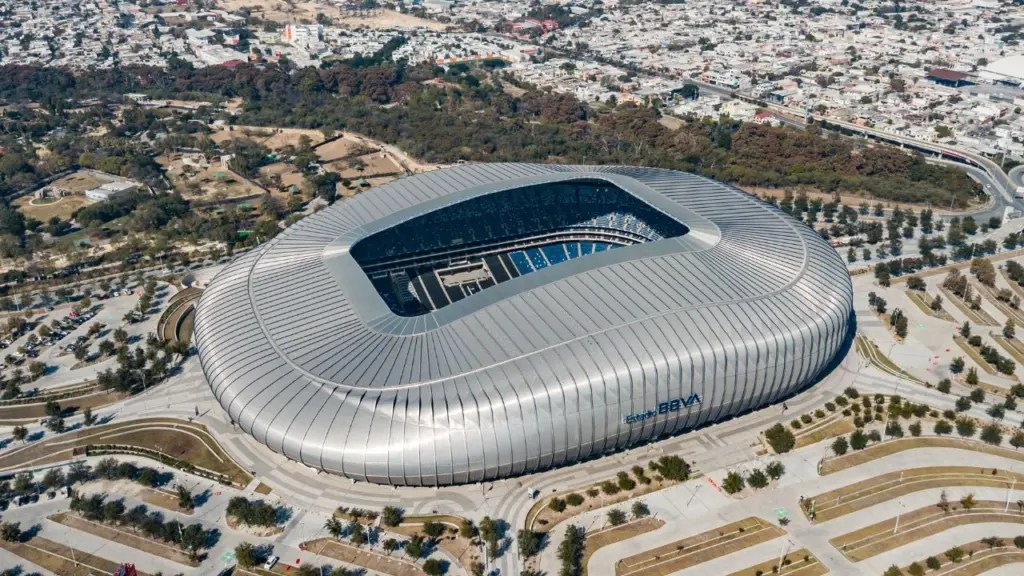
If you want the most jaw-dropping stadium backdrop of the entire tournament, Estadio BBVA in Monterrey is your answer — the jagged Cerro de la Silla mountain looms right behind it like a movie matte painting. Monterrey is hosting group-stage matches, and the setting alone is worth the trip. It’s also one of Mexico’s great industrial and cultural engines.
Seriously, look up a photo of this stadium. I’ll wait. Unreal.
| Detail | Info |
|---|---|
| Venue | Estadio BBVA, Guadalupe (Monterrey), Mexico |
| Nickname | “El Gigante de Acero” (The Steel Giant) |
| Role | Group-stage matches |
| Backdrop | Cerro de la Silla mountain |
| Schedule | See official FIFA fixtures |
Table of Contents
Monterrey on screen
Monterrey is one of the powerhouses of Mexican film and television — a major production hub whose dramatic Sierra Madre scenery, modern skyline, and historic Barrio Antiguo have backed countless features, series, and telenovelas. The contrast of glass towers against raw mountain rock gives directors a built-in epic frame. For Mexico’s World Cup story on screen, don’t miss our México 86 guide.
Make a movie-and-match trip
My plan: a group-stage match at the Steel Giant, then the Fundidora Park, the Macroplaza, and a cable-car view of those mountains. It photographs like a film set because, frankly, it basically is one. See the full lineup in our World Cup 2026 hub and compare with the USA vs Paraguay opener.
Then & now
Monterrey is part of Mexico’s third World Cup era — after 1970 and 1986, the country is co-hosting again in 2026. Exact match dates are on the FIFA fixtures page.
More Monterrey highlights
Monterrey frames beautifully. The historic Barrio Antiguo, the sprawling Macroplaza, and Parque Fundidora’s industrial-turned-cultural grounds all photograph like sets, while the Chipinque overlook hands you that mountain-meets-metropolis shot. As a longtime hub of Mexican film and television, the city knows how to host a production — and now it’s hosting the world.
For visitors, Estadio BBVA in suburban Guadalupe is the star attraction, and that Cerro de la Silla backdrop is unlike any other stadium setting on the planet — get there in daylight for photos. Monterrey is also Mexico’s industrial powerhouse, which means modern infrastructure, great food (cabrito is the local specialty), and easy access to mountain adventures like the Grutas de García caves.
My honest take: Monterrey is the most visually jaw-dropping stadium setting of the entire tournament, and I don’t think it’s close. The steel-and-glass skyline crashing into raw sierra gives every shot an epic, almost cinematic scale that no other host city can match. Add northern-Mexican hospitality and seriously good food, and it’s a stop worth building a trip around. See how it fits the bigger map in our World Cup 2026 hub and the USA vs Paraguay opener guide.
Frequently asked questions
What stadium is hosting the World Cup in Monterrey?
Estadio BBVA, nicknamed the Steel Giant, hosts group-stage matches with the Cerro de la Silla mountain as a backdrop.
Why is Estadio BBVA famous?
Its dramatic setting against the Cerro de la Silla mountain makes it one of the most striking stadiums in the world.
Is Monterrey a filming hub?
Yes, Monterrey is a major center for Mexican film and television production.
Discover more from A2Z Filming Location
Subscribe to get the latest posts sent to your email.